
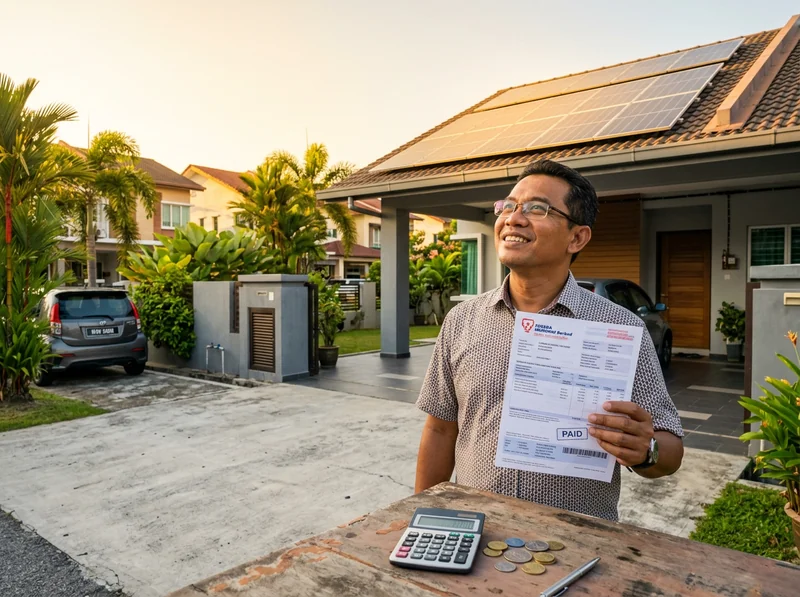
A typical residential solar system in Sabah costs between RM15,000 and RM55,000, depending on your roof size, power consumption, and system design. Commercial systems range from RM70,000 to over RM2 million. In 2026, prices have risen 10-15% due to global module cost increases, but ROI remains strong: most residential systems pay for themselves in 5-8 years.
What affects the price of a solar system?
Solar costs are driven by six main factors. The largest is system size (measured in kilowatts peak, or kWp): bigger systems have lower per-watt costs due to economies of scale. Your roof type matters too—concrete tiles cost more to mount than metal roofs. The inverter choice (string vs. hybrid vs. three-phase) can add RM5,000–15,000. Mounting complexity increases costs if your roof is steep, shaded, or structurally weak. Sabah logistics add 5-10% premium compared to Peninsular Malaysia due to shipping and local installation expertise. Finally, grid distance—if your switchboard is far from the roof, trenching costs rise.
How much does residential solar cost in Sabah?
Residential costs in Sabah typically follow this pattern:
| Property Type | System Size | Cost Range | Cost per kWp | Est. Monthly Savings |
|---|---|---|---|---|
| Terrace House | 4–5 kWp | RM15,000–22,000 | RM3,500–4,500 | RM400–550 |
| Semi-Detached | 7–9 kWp | RM26,000–38,000 | RM3,400–4,400 | RM700–900 |
| Bungalow | 10–15 kWp | RM35,000–55,000 | RM3,300–4,200 | RM1,000–1,500 |
Key insight for Sabah (updated July 2026): Sabah now has a residential net energy metering scheme — Solar Rakyat Sabah — so a domestic SESB account holder can export surplus solar and receive bill credits at the gazetted domestic tariff. Capacity is capped at 5 kWac single-phase or 10 kWac three-phase. Commercial and industrial systems still run under SELCO, where export is not permitted and every kWh of saving comes from self-consumption. Either way, system sizing matters: on SELCO, oversizing simply wastes generation. See how net energy metering works in Sabah for the full mechanics.
How much does commercial solar cost?
Commercial systems benefit from lower per-watt pricing due to larger scale, but installation complexity and three-phase wiring add costs. Here's the breakdown:
| System Category | System Size | Cost Range | Cost per kWp |
|---|---|---|---|
| Small Commercial | 20–50 kWp | RM70,000–175,000 | RM3,200–4,000 |
| Medium Commercial | 50–200 kWp | RM150,000–600,000 | RM2,800–3,800 |
| Large C&I | 200–1000 kWp | RM400,000–2,100,000+ | ~RM2,100 |
Commercial installations are attractive because electricity demand is highest during daylight hours (when panels generate most). Payback periods often run 3-5 years compared to 5-8 years for residential. Three-phase systems and battery backup (increasingly common) can add RM50,000–200,000, but improve resilience during grid outages.
What's the ROI and payback period?
Return on investment depends on three variables: system cost, monthly electricity bill savings, and annual electricity inflation.
Residential example: A 7 kWp system costs RM28,000 and generates RM700/month in savings (assuming RM4,000/month electricity bill). At zero inflation, payback is 40 months (3.3 years). With Sabah's typical 3–4% annual electricity rate hikes, payback accelerates to 5–6 years. Over a 25-year panel lifespan, total savings exceed RM150,000.
Commercial example: A 100 kWp system costs RM350,000 and generates RM4,500/month in savings (RM54,000/year). Payback: 78 months (6.5 years) at flat rates, or 4-5 years with rate inflation. Businesses save RM1 million+ over 20 years.
Key variables that improve ROI:
- Higher current electricity consumption (bill savings increase per kWh generated)
- Daytime load (commercial wins here)
- Low self-discharge battery systems (if added later)
- Regional rate increases (Sabah's rates rise predictably)
Are there any incentives or financing options?
Malaysia offers two key incentives that apply in Sabah:
1. Green Technology Financing Scheme (GTFS)
Available to residential and commercial customers. Banks offer loans at preferential rates (typically 1-2% below prime rate) for renewable energy projects. Loan tenors up to 15 years. Contact your bank or ask us for partner lender recommendations.
2. Green Investment Tax Allowance (GITA)
For commercial installations: 100% investment tax allowance on qualifying capital expenditure. This reduces corporate tax liability in the year of installation. Residential customers do not qualify.
3. Company-level sponsorship
Some multinationals and large corporations fund employee solar programs for sustainability goals—ask your HR team.
Why are 2026 prices higher than 2025?
Solar module prices rose approximately 10-15% between December 2025 and January 2026. Three factors drove this:
- Global supply chain tightness: China increased export tariffs on polysilicon, the raw material for solar cells.
- Shipping costs: Container rates from Asia to Malaysia rose due to Suez Canal disruptions and port congestion.
- Inverter chip shortages: Semiconductor supply remains constrained, pushing inverter costs up 8-12%.
Price outlook: Industry forecasts expect stabilization by Q3 2026 as supply normalizes. Early booking (next 30 days) may secure better rates before further increases.
How to get an accurate quote for your property
Our onsite quotation process takes 30 minutes and is free. Here's what we assess:
- Roof inspection: Orientation, tilt angle, shading, structural load capacity.
- Electrical audit: Current consumption, tariff plan, switchboard location, three-phase availability.
- Design options: We propose 2-3 system sizes with cost and ROI for each.
- Written quotation: Breakdown of modules, inverter, BOP (balance of plant), labor, warranty, and financing options.
Ready to see your custom quote? Message us on WhatsApp with your address, and we'll schedule your free site visit.
Frequently asked questions
Q: Do I need battery storage?
Not immediately. Most first-time customers install grid-connected systems (no battery) to minimize cost and maximize ROI. Batteries make sense if: (1) you want backup during blackouts, (2) your tariff has time-of-use pricing (charge at night, discharge at peak), or (3) you're off-grid. Battery costs RM15,000–50,000+ per kWh, so ROI is typically 8-12 years. We recommend adding batteries in Year 3-5 if your situation changes.
Q: What's the warranty on a solar system?
Panels: 25-30 year performance warranty (guarantee at least 80% output at 25 years). Inverter: 5-10 years (extendable to 15). Our installation: 10-year craftsmanship warranty. All equipment is original, not refurbished.
Q: Can I upgrade my system later?
Yes. Most systems are designed with expansion in mind—we leave room on your roof and oversize the switchboard. Adding 5-10 kWp later costs 10-15% less per kWp because labor and electrical work are largely done. Plan for expansion if your roof has space.
Q: How does cloud cover affect output in Sabah?
Sabah's equatorial climate brings frequent clouds, but not all clouds block sunlight. Diffuse light still generates 30-60% of peak output. Annual production typically runs 1,200-1,400 kWh per kWp (compared to 1,600 per kWp in sunnier regions). We size systems accounting for this—your quote includes realistic output assumptions.