
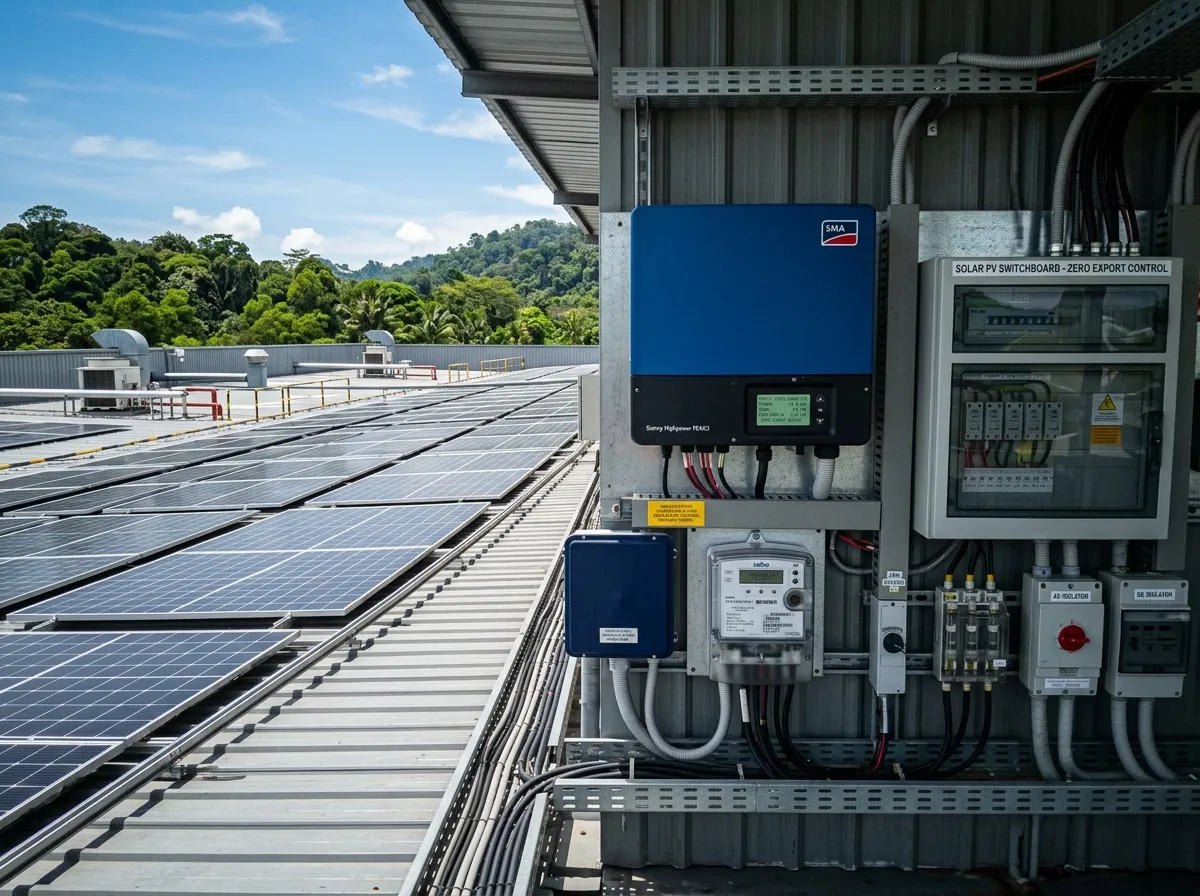
Zero export means your solar panels can only power your building — not send electricity back to the grid. This is a requirement of the SELCO-PV SABAH programme, which covers commercial and industrial self-consumption systems. Under SELCO, Sabah's energy regulator ECoS requires installations to be designed so that any surplus power is curtailed rather than exported to SESB's power lines.
Updated July 2026: zero export is no longer the rule for every system in Sabah. Domestic SESB account holders can now export surplus solar and receive bill credits under Solar Rakyat Sabah, the state's residential net energy metering scheme. If you are a homeowner, read how net energy metering works in Sabah — the zero-export rules on this page apply to SELCO business systems, not to you.
What does zero export actually mean?
In practical terms, zero export means:
- Your solar system connects to your building's internal electrical system only
- An inverter (or dedicated export control device) continuously monitors the amount of power flowing to the grid connection point
- If your solar generation exceeds your building's consumption at any moment, the inverter automatically reduces its output to zero — preventing any power from flowing back to SESB's lines
- Any solar energy that would have been "excess" is lost (unless you have battery storage installed)
Think of it like a traffic manager at a junction: if the road is already full, incoming traffic is halted. If the road (your building) has capacity, traffic (solar power) flows freely.
Why does Sabah have a zero export policy?
Sabah's power grid is fundamentally different from Peninsular Malaysia's. ECoS and SESB implemented zero export requirements for very specific technical and operational reasons:
Low Reserve Margin
Sabah's grid operates with only a ~12% reserve margin, compared to Peninsular Malaysia's ~30%. This tight buffer means sudden injections of uncontrolled solar power can easily destabilize the system.
Poor Grid Reliability
Sabah experiences approximately 5 hours per year of power interruptions, versus just 35 minutes in Peninsular Malaysia. A fragile grid cannot absorb uncontrolled distributed generation.
Aging Infrastructure
Much of SESB's transmission and distribution network uses bare or non-insulated conductors, which are vulnerable to voltage surges from sudden solar exports. Upgrading this infrastructure entirely would cost approximately RM4 billion — a burden the utility cannot bear quickly.
Subsidy Dependency
SESB relies on government subsidies (~RM866 million in 2024) to operate. Uncontrolled solar exports would reduce SESB's revenue, making the utility even more dependent on subsidies.
Limited Capital Expenditure
SESB's annual capex for transmission and distribution is approximately RM400 million. To safely accommodate significant solar exports, the utility would need to invest far more than this to reinforce the grid.
In short: Sabah's grid is not yet robust enough to handle uncontrolled two-way power flows. Zero export is a protective measure while infrastructure is modernized.
How does zero export compare to Solar Rakyat?
Since 2026 the answer in Sabah depends on your premises, not your state. A business runs under SELCO and cannot export. A home can run under Solar Rakyat and can. Here is the comparison:
| Feature | Sabah business (SELCO-PV) | Sabah home (Solar Rakyat NEM) |
|---|---|---|
| Export Allowed? | No — zero export required | Yes — excess power exported to grid |
| Value of Excess | None — energy is curtailed | Bill credits at the gazetted domestic tariff — never a cash payout |
| System Sizing | Match daytime usage, not oversized | Capped at 5 kWac single-phase / 10 kWac three-phase |
| Inverter Control | Must have zero-export limiter | Standard grid-tie inverter (no limiter needed) |
| Metering | Existing meter retained | Smart meter from SESB (RM400 single / RM450 three-phase) |
| Battery Storage | Optional (helps capture curtailed energy) | Permitted, but for self-consumption only |
| Credit Expiry | Not applicable | Credits carry forward 12 months, then lapse |
The result: a SELCO business system in Sabah needs careful design to match your actual usage patterns, because any generation you do not consume is simply lost. A residential Solar Rakyat system is more forgiving, since surplus becomes a bill credit rather than being curtailed — but it is capped at 5 kWac single-phase or 10 kWac three-phase, so it cannot be oversized either.
How does the zero export limiter work?
Here's the technical side in simple terms. A zero export system has three key components:
Component 1: Smart Meter or CT Clamp
Installed at your grid connection point (where SESB's lines meet your building). It measures the instantaneous power flow in real-time — either flowing in from SESB (you're buying) or flowing out to SESB (you're exporting).
Component 2: Inverter with Export Control
Your solar inverter receives a signal from the smart meter or CT clamp. If it detects that your solar generation would exceed your consumption, the inverter automatically reduces its output — preventing any net flow back to the grid.
Component 3: Building's Distribution Board
Your solar power flows directly into your internal electrics (lights, air conditioning, machinery, etc.). Only any surplus that WOULD have gone to the grid is curtailed. Power for your own use flows freely.
Example: Imagine a 10 kW solar system on a warehouse with peak daytime consumption of 8 kW. On a sunny day, the system generates 10 kW, but only 8 kW is used on-site. The remaining 2 kW is curtailed by the inverter — it never reaches the grid.
Does zero export mean I waste solar energy?
Technically yes, but it's not as wasteful as it sounds if you size your system correctly.
If you dramatically oversize your solar system (e.g., a 50 kW system for a building that uses only 10 kW in the daytime), then yes, most of that power is wasted. This would be a poor investment in Sabah.
However, if you right-size your system to match your typical daytime consumption profile, you'll use most of what you generate. Any small curtailment happens only on exceptionally sunny days when your building's load is unusually low.
Battery storage changes this equation: If you add a battery system (BESS), you can store the "excess" power that would otherwise be curtailed. You then use that stored energy in the evening and night. Current regulations require BESS only for systems larger than 1 MWac, but smaller systems can also add batteries for self-consumption optimization.
Will Sabah extend net metering to businesses?
Net energy metering already exists in Sabah for homes — that is Solar Rakyat Sabah, opened in 2026 for domestic SESB account holders. No equivalent export route has been announced for commercial or industrial premises, which is why SELCO remains zero-export. Extending export to business-scale systems is a bigger ask of the grid, and ECoS and SESB would need to:
- Upgrade transmission and distribution infrastructure (especially bare conductors to insulated cables)
- Deploy more advanced monitoring and control systems for a two-way grid
- Increase the grid's reserve margin above 12%
- Agree on export pricing (who compensates SESB for solar injections?)
As of 2026 there is no announced timeline for extending net energy metering to commercial and industrial premises in Sabah, so zero export remains the rule for SELCO systems. Residential customers do not need to wait — net energy metering is open to Sabah homes now under Solar Rakyat, subject to a 20 MW quota and a 30 June 2028 closing date.
What should I do to maximize savings under zero export?
Since you can't export power for revenue, focus on maximizing on-site consumption:
1. Right-Size Your System
Work with an engineer to analyze your hourly consumption pattern (especially between 9 AM–3 PM, peak solar hours). Size your system to match this profile, not your annual bill. A 10 kW system that uses 9 kW most days is better than a 20 kW system that exports half its power.
2. Shift High-Load Activities to Daylight
Run washing machines, industrial equipment, air compressors, and water pumps during peak solar hours (9 AM–2 PM) if possible. This increases self-consumption and reduces reliance on grid power.
3. Consider a Battery System
Even a modest 10–20 kWh battery lets you store daytime solar excess and use it in the evening. This extends your effective operating hours and further reduces grid purchases. Costs have dropped significantly; it's worth evaluating ROI for your use case.
4. Monitor Your System Regularly
Use your inverter's app or monitoring portal to see how much energy you're generating vs. using. If you're consistently curtailing large amounts, it might indicate oversizing or a shift in your building's usage patterns.
5. Plan for Growth
If your business is growing (and will consume more power in future years), design your solar system for tomorrow's usage, not today's. This future-proofs your investment.
Not sure what size system fits your usage?
Every building in Sabah has a unique consumption pattern. Our engineers analyze your electricity bill and usage profile to design a zero-export system tailored to your site.
WhatsApp Us Your Bill →Frequently Asked Questions
Q: Can a SELCO business system be switched to net metering later?
A: No. Sabah's net energy metering scheme, Solar Rakyat, is for domestic SESB account holders and is capped at 5 kWac single-phase or 10 kWac three-phase — a commercial system cannot simply convert to it. If export is ever extended to business premises you may need to change the inverter or export control device, so it is worth choosing equipment with that in mind. Do not delay a SELCO installation waiting for it.
Q: What happens if my inverter fails and I'm exporting power?
A: Your system is designed with safety interlocks. If the inverter or export limiter fails, the entire system automatically disconnects from the grid (islanding prevention). You'd have no solar power until it's repaired.
Q: Does zero export affect my payback period?
A: Yes — typically by 2–4 years. Without export revenue, your return on investment comes purely from reducing grid purchases. However, solar is still financially attractive in Sabah due to high grid electricity costs and consistent sunshine.
Q: Can I add more solar panels later if my business grows?
A: Yes, but you'll need to stay within the zero export limit. If you add panels, the total system must still be designed not to export. You may also need to upgrade your inverter or export control device to handle the larger capacity.